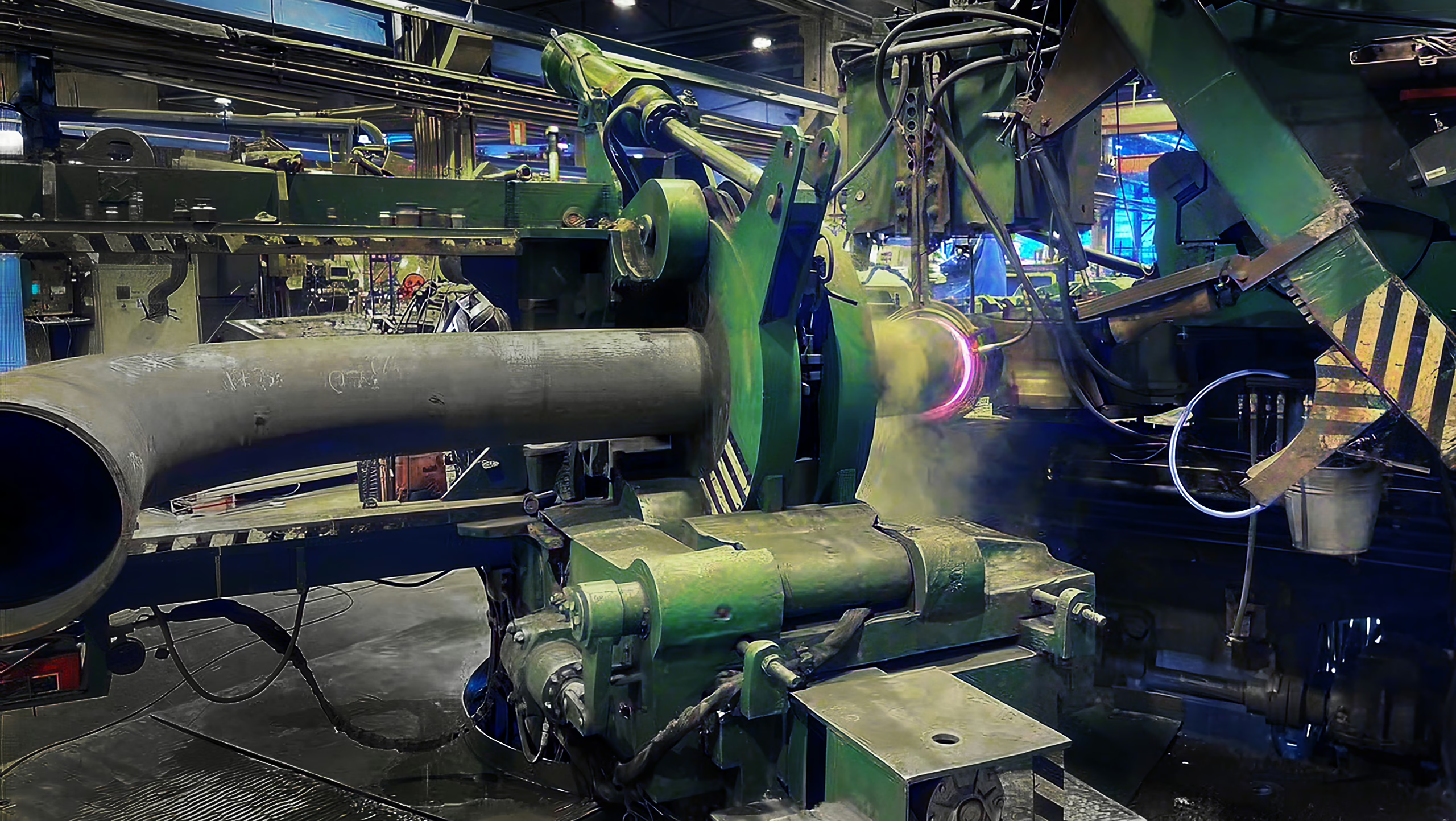
Three metres below the factory floor sits a massive, mechanical giant. For nearly 50 years, through changing market conditions, geopolitical shifts and the rise of digital technology, the UZTM-500 has remained the cornerstone of Ylivieska. As we celebrate our 50th anniversary, this unique bending machine is still in daily use – and without it, the factory might not exist today.
Every day, an operator steps up onto the raised platform, looking down into the three-metre-deep basement where most of the machinery resides. Over the decades, three generations of operators have stood on this platform, guiding the UZTM-500 as it has produced tens of thousands of bends. Looking back, it all started with a major strategic decision in the late 1970s.
A groundbreaking acquisition
In 1978, the Ylivieska factory was owned by the Wärtsilä Group, and most of its production served the company’s shipyards. However, the workload was highly unpredictable, making long‑term planning difficult.
At the same time, the two major power and pulp boiler manufacturers in Finland – Ahlström
in Varkaus and Tampella in Tampere – required extensive piping systems. But their specifications for materials, dimensions, and wall thicknesses were far beyond what Ylivieska’s existing equipment could handle.
Management saw an opportunity to establish a new, more stable business segment in the energy industry. This idea led to a bold decision – to invest in the first induction bending machine in Northern Europe.
Pioneering a new industry
Because Wärtsilä delivered many ships to the Soviet Union at the time, the new machine was acquired through a countertrade arrangement with the USSR. It arrived in 1979, accompanied by engineers from the manufacturer to oversee the installation. Hannu Isokoski was employed for the commissioning of the machine and the development of the process.
“Induction bending was a completely new method in Europe, so getting customer and regulatory approval took time,” says Hannu. “Before we could even begin any commercial production, the factory had to carry out extensive procedure tests and qualification trials.”
The first bends were finally sold to Ahlström in 1982. This moment marked the birth of industrial pipe prefabrication for the energy sector in Northern Europe. What began as a pure delivery of bends evolved into the factory’s most significant product segment. Today, the delivery chain covers everything from design to installation.
Surpassing modern machines
While the machine has been upgraded many times, its frame remains completely original. New machines might have advanced computerised controls but typically function with a free-bending arm. The UZTM500 features an additional, controlled bending arm that enables bends with a constant radius – a capability believed to be unique in Europe.
“It’s a beast, and its mechanical functionalities still surpass most modern alternatives,” says Veikko Suihkonen, Unit Manager in Ylivieska. “By pushing back with significant force, we can achieve incredibly tight bending radii while still controlling the wall thickness on the outside of the bend.”
The UZTM500 is more than just machinery. It represents a bold decision that reshaped the factory’s future. Today, its legacy continues with every pipe it bends, supporting the energy industry just as it did 50 years ago.
Technical specifications of the UZTM500
Power: 400 kW
Pipe diameter: Ø 88.9–508 mm
Wall thickness: 4–80 mm
Minimum bending radius: 1.5 × D
Maximum bending radius: Approx. 5000 mm